What if your skin could receive a message that says:
“It’s time to repair.”
That’s the big idea behind GHK Cu.
This tiny copper peptide is being studied for collagen, skin firmness, smoother texture, repair, and healthy looking skin.
It has even earned nicknames like the “beauty peptide” and the “glow peptide.”
But GHK Cu has another side that people don’t always talk about.
The injectable form can burn. For some people, that sting can be surprisingly strong.
GHK Cu may be exciting, but the full story needs to include both the glow and the sting.
The simple answer
GHK Cu is a small peptide that carries copper.
Your body naturally contains GHK. When GHK binds with copper, it becomes GHK Cu.
Think of GHK as a delivery truck.
Copper is the tool inside the truck.
Together, they may help deliver signals connected with collagen, skin repair, and tissue renewal.
GHK Cu has been studied in skin cells, tissue, animals, and some small human studies. Most of the beauty interest is connected with topical use and skin research.
Benefit 1: Collagen support
Collagen acts like the support beams inside your skin.
It helps skin look firm, full, and smooth.
As collagen changes with age, skin may become thinner. Fine lines may become easier to see. Skin may not bounce back as quickly.
GHK Cu has been shown in laboratory research to support the activity of fibroblasts. These are the cells that help make collagen and other parts of the skin’s support system.
Why does this matter?
Supporting collagen isn’t only about chasing younger skin.
It may help skin look stronger, smoother, and better supported.
That can help someone feel more confident without trying to look like a different person.
Benefit 2: Firmer and smoother looking skin
GHK Cu is often added to skincare products made for fine lines, rough texture, and loss of firmness.
Some older and smaller studies reported improvements in skin thickness, firmness, fine lines, and the overall look of aging skin. Reviews also note that the amount of strong human research is still limited.
This is important because skincare marketing can move faster than the science.
GHK Cu has real reasons to be interesting. But it isn’t a magic eraser.
Think of it more like a coach for the skin’s repair team.
It may help guide the work. It doesn’t rebuild everything overnight.
Benefit 3: Skin repair and renewal
GHK Cu was first noticed because of its connection to tissue repair.
Researchers have studied how it may support wound healing, new blood vessel growth, skin cell movement, and the rebuilding of damaged tissue.
Much of this work comes from laboratory and animal research, but it helps explain why GHK Cu became so popular in the beauty world.
Why does repair matter for beauty?
Healthy looking skin isn’t only about covering lines.
Skin that repairs well may look calmer, smoother, and more even.
It may also recover better from the daily stress caused by weather, dryness, and the environment.
Benefit 4: Hydration and a healthier glow
GHK Cu may support substances called glycosaminoglycans.
That name sounds huge, but the idea is simple.
These substances help the skin hold water.
Think of them as tiny moisture sponges inside the skin.
Better water support may help skin look softer, fuller, and more radiant.
That’s the benefit behind the glow.
It isn’t about shiny skin. It’s about skin that looks cared for, comfortable, and alive.
Benefit 5: Protection from everyday skin stress
Daily life creates stress for the skin.
Sunlight, pollution, dryness, and normal cell activity can create unstable molecules called free radicals.
Too many free radicals can damage cells.
GHK Cu has shown antioxidant and calming activity in laboratory research. This may help protect skin cells while the repair team does its work.
This doesn’t replace sunscreen.
Think of sunscreen as the roof over the house.
GHK Cu may support some of the repair work happening inside.
You still need the roof.
Benefit 6: Hair and scalp interest
Copper peptides are also being explored for hair and scalp health.
Related copper peptide research suggests they may affect cells around the hair follicle. This has led to interest in hair strength, follicle support, and the hair growth cycle.
The research here is still early, and related copper peptides aren’t always the same as GHK Cu.
GHK Cu shouldn’t be presented as a proven answer for hair loss.
Still, the idea is interesting.
A healthier scalp and better supported follicles may help create a stronger setting for healthy looking hair.
Injectable or topical?
GHK Cu is commonly discussed in two very different forms.
Topical GHK Cu
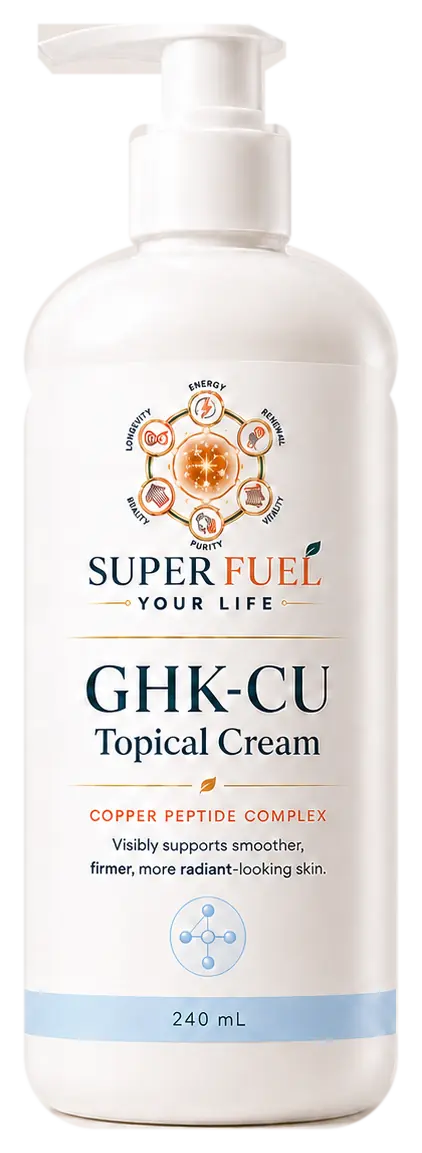
Topical GHK Cu is applied to the skin in a cream or serum.
This is the form most connected with beauty, fine lines, firmness, texture, hydration, and visible skin aging.
Topical use places the peptide where many people want the benefit most.
Research has shown that GHK Cu can move into human skin under laboratory conditions.
The SFYL GHK Cu Topical Cream also includes skin supporting ingredients such as hyaluronic acid, amino acids, glycerin, urea, PCA, inulin, and allantoin.
The goal is to support smoother, firmer, hydrated, and more radiant looking skin without injection discomfort.
Injectable GHK Cu
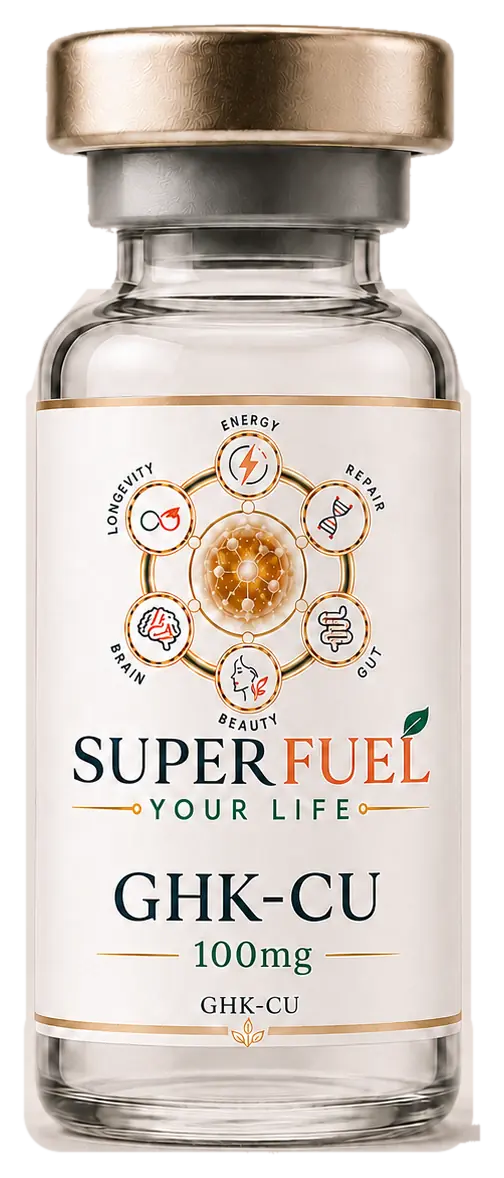
The injectable form is discussed for wider tissue and whole body effects.
However, this is where the evidence and safety picture become much less clear.
The FDA says compounded injectable GHK Cu may carry risks linked with immune reactions, peptide clumping, and impurities. Human safety information is limited.
Injectable GHK Cu shouldn’t be treated like an ordinary beauty treatment.
It’s a different route with different risks.
Let’s talk honestly about the burning
GHK Cu injections have earned a reputation for being “spicy.”
Some people describe a quick sting.
Others describe a sharp burn that feels like a bee sting. The area may continue to ache, feel hot, or become irritated afterward.
Why can this happen?
Injection pain can be affected by:
- The acidity of the solution
- How concentrated the solution is
- The formula’s salt balance
- The temperature of the solution
- Local tissue irritation
- The ingredients and quality of the finished product
Research on injections in general shows that solutions far from the body’s natural pH can cause more pain and irritation.
The exact cause of GHK Cu burning hasn’t been clearly proven.
Copper may play a part. The formula may play a part. Product quality may play a part.
The important message is this:
Pain isn’t a measure of quality.
More burning doesn’t mean more collagen.
An intense or lasting reaction shouldn’t be laughed off as “the price of beauty.”
Severe pain, spreading redness, heat, swelling, hives, drainage, fever, or trouble breathing needs medical attention.
Can topical GHK Cu burn too?
Topical GHK Cu is usually much easier to use, but it can still bother sensitive skin.
Possible reactions include:
- Stinging
- Redness
- Itching
- Dryness
- A rash
- Breakouts
Using several strong skincare ingredients at once may make irritation more likely.
A small patch test can help show how your skin responds before applying a product over a larger area.
A brief light tingle isn’t the same as ongoing burning.
If a product causes strong or lasting burning, wash it off and stop using it. Skin doesn’t need to suffer to improve.
Why topical may make more sense for beauty goals
If the goal is smoother, firmer, more hydrated looking skin, topical GHK Cu offers a direct route.
It puts the peptide onto the skin.
It can become part of a normal skincare routine.
And it avoids the injection sting that makes GHK Cu so uncomfortable for some people.
That doesn’t mean every topical formula will work the same. The full formula, strength, stability, and how well it reaches the skin all matter.
But for someone focused mainly on visible skin benefits, topical GHK Cu may be the more natural place to begin learning.
What we know
GHK is a natural copper binding peptide found in the body.
GHK Cu has been studied for collagen, skin remodeling, tissue repair, and antioxidant activity.
Topical GHK Cu is the form most closely connected with beauty and skincare.
Some research suggests benefits for firmness, texture, fine lines, and overall skin appearance.
Injectable GHK Cu can cause strong stinging or burning for some people.
Topical GHK Cu may cause irritation in sensitive skin.
What we’re still learning
We don’t know how much topical GHK Cu reaches deeper skin in every formula.
We don’t know whether stronger creams always provide better results.
We don’t have clear proof that injectable GHK Cu creates better beauty results than topical use.
We don’t fully understand the long term safety of injectable GHK Cu.
Hair and scalp research remains early.
Many online beauty claims are stronger than the available evidence.
The bigger picture
GHK Cu has earned attention for good reason.
It’s connected with collagen, skin repair, moisture support, firmness, and the systems that help skin renew itself.
But real beauty education should include the full story.
The injectable form may burn badly.
The topical form may be more comfortable, but it can still irritate sensitive skin.
And neither form can replace sunscreen, sleep, protein, hydration, and a skincare routine your skin can handle.
The real promise of GHK Cu isn’t turning back time.
It’s helping support skin that looks stronger, smoother, healthier, and more alive.
That’s the kind of beauty that still looks like you.
KEEP EXPLORING
Keep exploring
Continue learning with:
SOURCES
Sources
- Pickart L and Margolina A. Regenerative and Protective Actions of the GHK Cu Peptide in the Light of the New Gene Data. International Journal of Molecular Sciences. 2018.
- Pickart L. The human tri peptide GHK and tissue remodeling. Journal of Biomaterials Science, Polymer Edition. 2008.
- Dou Y, et al. The potential of GHK as an anti aging peptide. Aging Pathobiology and Therapeutics. 2020.
- Mortazavi SM, et al. Topically applied GHK as an anti wrinkle peptide: Advantages, problems and prospective. BioImpacts. Published online 2024; volume 15, 2025.
- Hostynek JJ, et al. Human skin retention and penetration of a copper tripeptide in vitro as function of skin layer towards anti inflammatory therapy. Inflammation Research. 2010.
- Miller TR, et al. Effects of topical copper tripeptide complex on CO2 laser resurfaced skin. Archives of Facial Plastic Surgery. 2006.
- United States Food and Drug Administration. Certain Bulk Drug Substances for Use in Compounding that May Present Significant Safety Risks. GHK Cu, injectable routes.
- St Clair Jones A, et al. Understanding and Minimising Injection Site Pain Following Subcutaneous Administration of Biologics: A Narrative Review. Rheumatology and Therapy. 2020.
This article is for education only. It isn’t medical advice or a recommendation to use injectable GHK Cu.